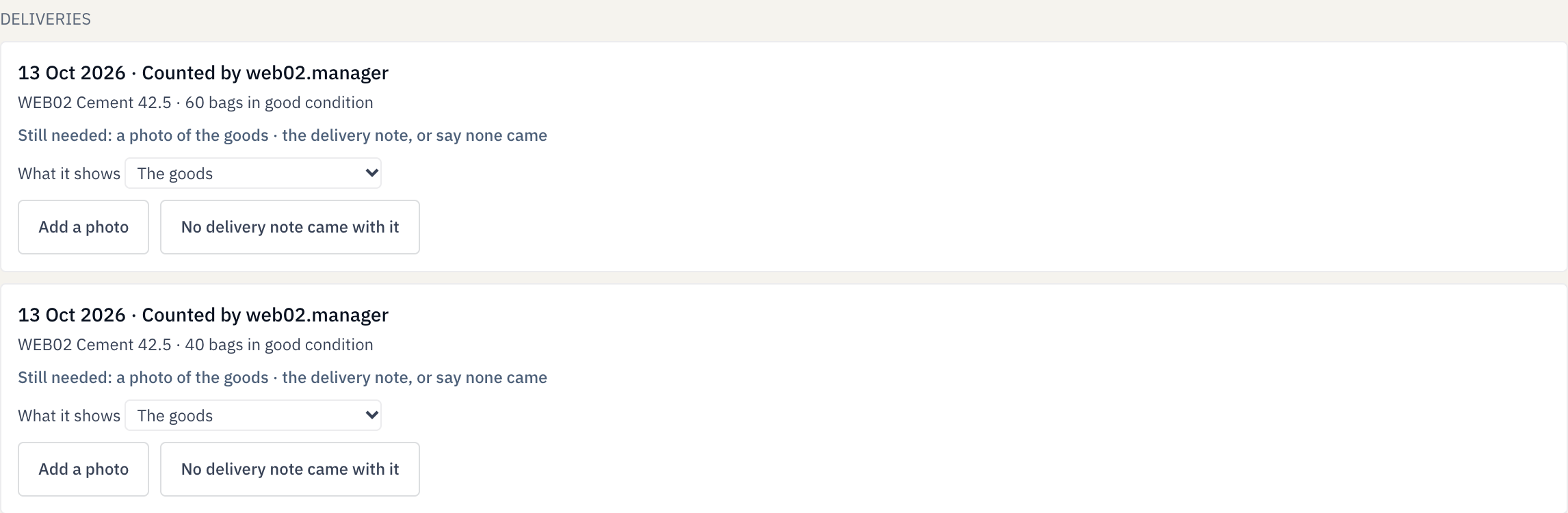
Can one order arrive in parts?
Yes. The accepted example records 60 bags, then 40 against the same 100-bag order. A remaining quantity belongs to that point in the delivery history; it must not be confused with the final balance.
BridgeBuild · Materials and costs
What was ordered, what arrived, what remains, which project used it, and what cost was recorded? BridgeBuild is construction project software that connects the material records behind those answers. Recorded cost remains separate from payment and physical progress.
Six records · Different questions
For purchasing, site, operations and finance teams, a delivery and its later use are different events. BridgeBuild keeps those records distinct.
| Record | What it tells you | What it does not tell you |
|---|---|---|
| Order | The material and quantity ordered from a supplier. | Whether it arrived, was used or was paid for. |
| Receipt | The quantity recorded as arriving at a warehouse, including part deliveries. | Whether that stock has been issued to a project. |
| Stock | The recorded quantity remaining and its stock value. | Cash available or independently verified material on site. |
| Issue to project | Which project received the allocation and how much was issued. | Whether the physical work is complete. |
| Recorded cost | The project cost arising from the material issue at its recorded stock cost basis. | A cash payment, selling value or the total cost of construction. |
| Payment | A separate record of cash movement. | Proof of delivery or construction progress. No payment was demonstrated here. |
One order · Two projects
Fictional USD demonstration · 14 October 2026. These responsive web records show one material’s movement, not a customer outcome or a complete project budget.
A manager recorded 60 bags, then 40 bags. After the first delivery, 40 were outstanding. The saved receipt screen includes both deliveries: 100 received, 0 remaining on the order.
Before project use, the intermediate stock was 100 bags × USD 6.50 = USD 650. That is recorded stock value, not cash paid.
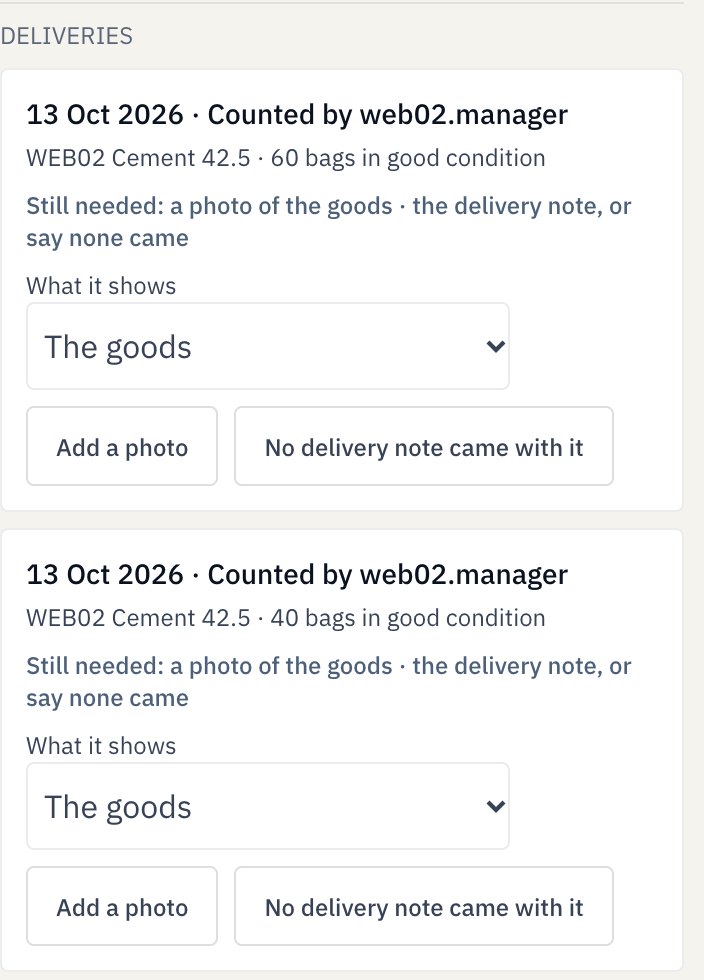
The administrator reopened this saved history. Delivery photos and delivery-note attachments were not supplied; the missing-file prompts remain visible.
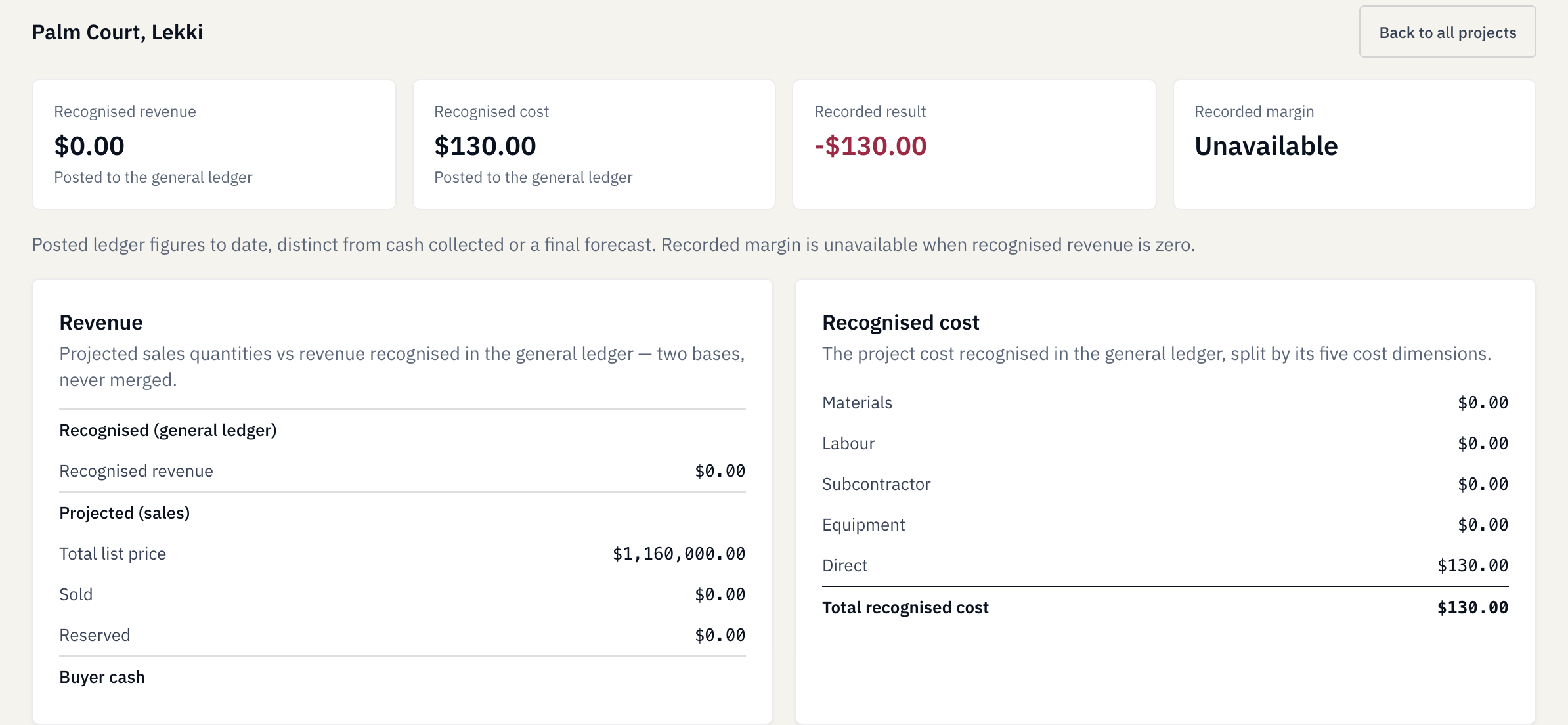
An existing permitted administrator issued 20 bags to Palm Court and 10 to Client Refurbishment. The issue used the recorded weighted-average stock basis of USD 6.50 per bag.
No payment took place. The project costs are the recorded values of these issues, not full construction costs, sales values or progress measures. The example does not establish manager access to every step.
 Enlarge view
Before you choose
Yes. The accepted example records 60 bags, then 40 against the same 100-bag order. A remaining quantity belongs to that point in the delivery history; it must not be confused with the final balance.
No. Receipt adds stock to a warehouse. A later allocation identifies the project and quantity issued, with its recorded cost. Receiving all 100 bags does not mean all 100 have been used.
The issue uses the recorded weighted-average stock cost basis. Here it is USD 6.50 per bag, giving USD 130 and USD 65 for the two issues. That is an example basis, not a universal rate or BridgeBuild’s price.
No. Recorded material cost and cash movement are separate. This demonstration reconciles stock issues to project costs but includes no payment or payable settlement.
It establishes that a file is attached to a record. It does not independently verify the time, location or completion of work. The separate client-job gallery example has no supplied capture time or location; these delivery records have no supplied photos.
A manager recorded receipts; an existing administrator allocated stock and reviewed costs. The company needs configured suppliers, materials, warehouses, projects and permissions appropriate to each role. Assess your team’s access in a demo.
Bring your delivery, warehouse and project-use questions. Follow the ungated materials tour, then request a trial or optional demo to discuss your records, role requirements and setup. Wider paid scope is agreed in a tailored proposal.
A practical next step
Try BridgeBuild free for 30 days with one project and one property unit within it, plus up to three property listings on one company website.
Listings are separate adverts, not extra managed units or extra websites. Request through our contact form; the team arranges setup. A demo is optional. A receipt confirms your request, not activation or the start of your trial.
For wider or continued paid use, request a tailored quote. Your proposal specifies setup, data preparation, training, support, charges and limits.
Pricing and onboardinghi@bridgebuild.app